


close
Choose Your Site
Global
Social Media

Transitioning to on-site nitrogen generation transforms your gas supply strategy. It shifts the resource from an operational vulnerability to a highly controlled asset. Facilities rely heavily on steady inert gas flows. They need these flows to maintain uninterrupted production schedules. Standard industrial gas often falls short.
For critical applications, basic nitrogen is never enough. Specifying a high-purity Nitrogen Generator requires a delicate balance. You must weigh exact oxygen tolerances against actual energy consumption. Over-purifying wastes immense amounts of compressed air. Under-purifying compromises your product integrity entirely.
This guide provides a robust technical framework. We explore how to evaluate, size, and implement high-purity nitrogen systems. You will learn how to match separation technologies to specific industrial processes. We will also dissect the critical difference between gas purity and overall system cleanliness.
On-site high-purity nitrogen generation eliminates cylinder delivery dependencies, boil-off waste, and supply chain volatility.
Required purity levels directly dictate the choice of technology: Membrane systems serve mid-tier needs (up to 99.5%), while Pressure Swing Adsorption (PSA) is mandatory for ultra-high purity (99.999%).
Over-specifying nitrogen purity exponentially increases compressed air demands and operational costs; precise application matching is critical for ROI.
Nitrogen purity (oxygen content) and cleanliness (moisture, particulates, oil) are distinct metrics requiring separate filtration and monitoring strategies.
Relying on delivered bulk liquid or cylinder nitrogen introduces significant hidden logistics. Facilities constantly face rental fees for storage tanks. Gas suppliers add unpredictable delivery surcharges. Workers must navigate hazardous handling procedures safely. Furthermore, bulk liquid systems suffer from natural boil-off. You can lose up to 20% of your nitrogen simply by storing it outdoors.
Generating gas internally stabilizes your core supply chain. An on-site generator gives you direct control over production schedules. You no longer wait on delayed delivery trucks during bad weather. You produce precisely what you need, exactly when you need it. This internal control buffers your facility against external market fluctuations. It secures an endless supply of inert gas.
Risk mitigation stands as a primary operational benefit. External supply chain shocks frequently shut down manufacturing plants. Generating gas on-demand protects your active production lines. A base-load generation system handles steady daily needs seamlessly. You avoid the catastrophic downtime associated with unexpected vendor shortages. We constantly see facilities dramatically improve their operational uptime after installation.
You must apply one vital engineering rule of thumb. Do not generate 99.999% purity if your process only requires 99%. Generating excess purity wastes massive volumes of compressed air. Match your generator precisely to your specific application requirements. Below, we break down standard industrial classifications.
Food manufacturers flush packaging lines to displace atmospheric oxygen. This prevents rapid oxidation of perishable goods. Removing oxygen effectively inhibits aerobic bacterial growth. It extends product shelf life significantly. Coffee, snack foods, and bottled beverages rely heavily on these specific purity levels. Too much oxygen leads to stale flavors and product spoilage.
Metal fabrication requires strict environmental control at the cutting head. Nitrogen acts as an assist gas during laser cutting operations. It prevents oxide edge formation on mild and stainless steel. A clean, oxide-free cut ensures immediate weldability. Operators skip secondary grinding or chemical cleaning steps entirely. This speeds up overall manufacturing output.
Electronic component manufacturing happens in strictly inert environments. Wave soldering and reflow soldering processes demand ultra-low oxygen levels. Even trace oxygen causes rapid oxidation on solder joints. This oxidation ruins sensitive semiconductor components and printed circuit boards. Facilities utilize constant blanketing to guarantee flawless electronic connections.
Pharmaceutical processes tolerate virtually zero oxygen exposure. Active pharmaceutical ingredients (APIs) degrade rapidly upon atmospheric contact. Facilities blanket storage tanks and mixing vessels constantly. Analytical instruments like Liquid Chromatography-Mass Spectrometry (LC-MS) require trace-level purity. Oxygen contamination heavily compromises data integrity and patient safety.
Application Purity Requirements Table
Industry / Application | Standard Purity Required | Maximum Allowable Oxygen | Primary Purpose |
|---|---|---|---|
Food & Beverage Packaging | 99.0% – 99.9% | 0.1% to 1.0% | Prevent spoilage and extend shelf life |
Laser Cutting (Stainless) | 99.9% – 99.95% | 0.05% to 0.1% | Prevent oxide edge formation |
Electronics Soldering | 99.99% – 99.999% | 10 ppm to 100 ppm | Eliminate joint oxidation |
Pharmaceuticals (APIs) | 99.999%+ | <10 ppm | Protect sensitive chemicals and analytical data |
You must carefully manage the inverse relationship between purity and flow rate. As target purity requirements increase, your output volume drops. The volume of nitrogen generated per cubic foot per minute (CFM) of compressed air decreases significantly. Pushing a Nitrogen Generator to ultra-high purities restricts its overall flow capacity.
The air-to-nitrogen ratio dictates your baseline energy efficiency. Generating 99% purity demands relatively low compressed air energy. Hitting 99.999% requires vastly more feed air to strip out the final oxygen molecules. You force the separation media to work much harder. Understanding this ratio helps you avoid overworking your compressors.
Chart: Estimated Air-to-Nitrogen Ratio by Purity Target
Target Purity Level | Estimated Air-to-Nitrogen Ratio (PSA) | Impact on Compressor Load |
|---|---|---|
95.0% | ~2.0 : 1 | Very Low |
99.0% | ~2.5 : 1 | Low |
99.9% | ~3.5 : 1 | Moderate |
99.99% | ~5.0 : 1 | High |
99.999% | ~7.0 : 1 | Very High |
Proper sizing logic requires evaluating your peak flow requirements. You should never size a system based purely on average daily usage. Sudden demand spikes will overwhelm an undersized generator unit. Instead, incorporate a strategically sized buffer tank. Receiver tanks store excess nitrogen during low-demand periods. They instantly release this reserve during sudden demand spikes. This handles surges smoothly without requiring a massively oversized generator.
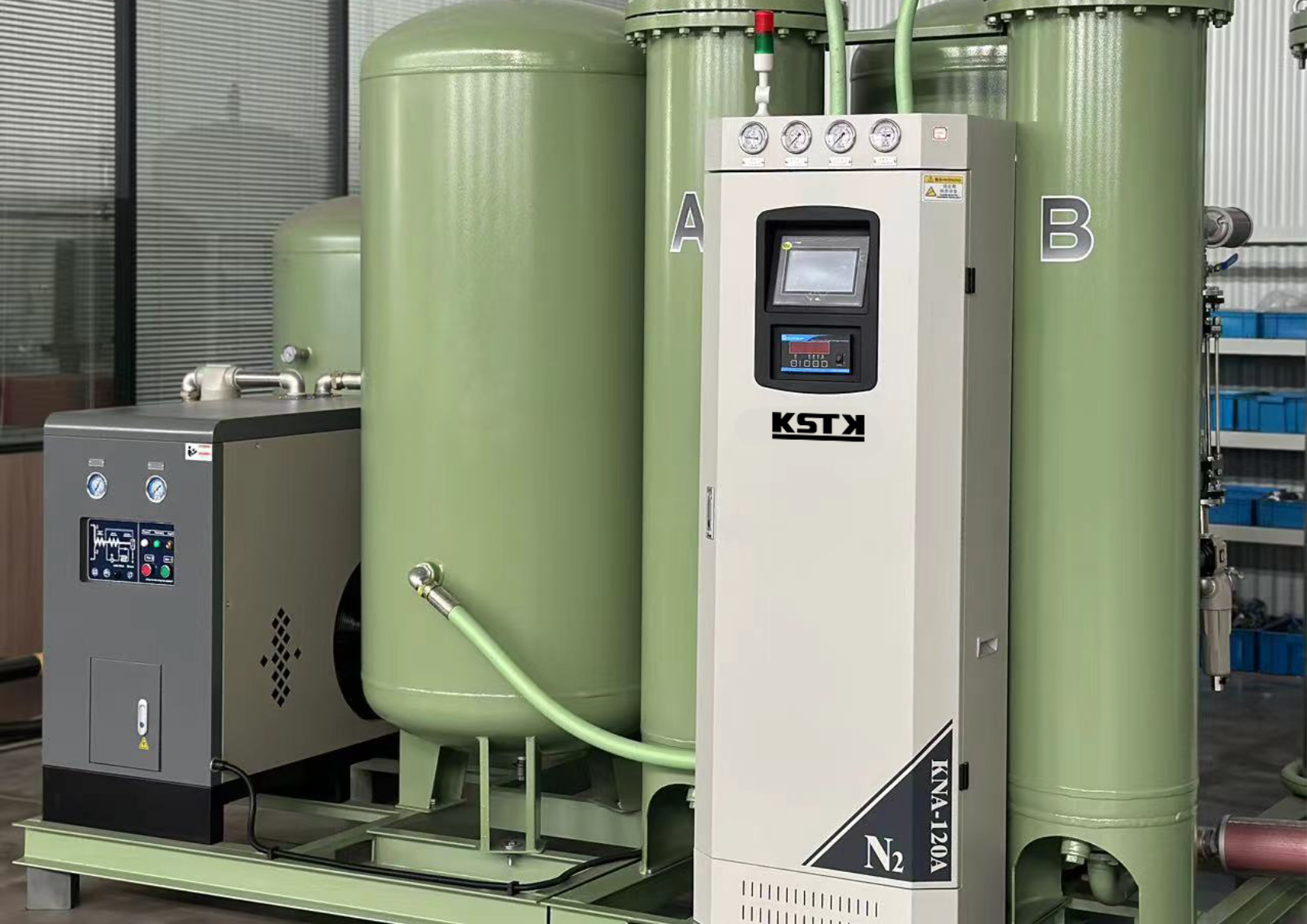
Selecting the appropriate separation technology dictates your long-term success. The two primary methods serve entirely different application profiles. You must align the technology with your specific gas demands.
Membrane systems utilize thousands of microscopic hollow fiber tubes. Feed air travels down the bore of these specialized fibers. Oxygen molecules permeate the fiber walls rapidly and exhaust outward. Nitrogen molecules travel slower and remain inside the tube bore. They exit the far end as a purified gas stream.
Best for: Applications requiring 95% to 99.5% purity.
Pros: These units feature a smaller physical footprint. They operate continuously without complex moving parts. They require lower initial capital setups and run silently.
Cons: They remain entirely incapable of reaching ultra-high purity efficiently. High purity demands degrade their output volume dramatically.
PSA systems utilize twin towers filled with a Carbon Molecular Sieve (CMS). Compressed air enters the first active tower under high pressure. The CMS media features precisely sized pores. These pores physically trap smaller oxygen molecules. The larger nitrogen molecules pass through untouched. When the sieve saturates, the tower depressurizes to vent the oxygen. The system simultaneously switches airflow to the second tower.
Best for: Critical applications requiring 99.9% to 99.999% purity.
Pros: They deliver exceptional efficiency at ultra-high purities. The CMS boasts a remarkably long lifespan if properly maintained. They provide rock-solid purity consistency.
Cons: The twin-tower design requires a larger physical footprint. They rely on sequencing valves which require eventual maintenance.
Many plant managers incorrectly confuse gas purity with system cleanliness. We must clarify this critical distinction immediately. Purity refers strictly to the ratio of nitrogen molecules to oxygen molecules. Cleanliness refers entirely to the absence of external contaminants. These contaminants fall under ISO 8573-1 air quality standards. They include solid particulates, liquid water aerosols, and heavy oil vapors.
Your incoming feed air dictates the survival of your generation system. High-purity generators fail rapidly if fed poorly treated compressed air. Oil carryover from lubricated compressors permanently ruins delicate separation media. You must install aggressive filtration trains upstream. This typically includes coalescing filters to catch liquids. Carbon towers strip away lingering oil vapor. Refrigeration or desiccant dryers aggressively remove harmful moisture.
Continuous monitoring guarantees absolute process safety. Relying on blind operation invites disaster. You should integrate zirconia or galvanic oxygen sensors directly into the gas stream. Install dew-point monitors to watch for moisture breakthroughs. These sensors create a permanent, auditable trail of gas quality. More importantly, they trigger automatic system shutoffs if purity ever drops below acceptable thresholds.
Deploying new equipment impacts your existing facility infrastructure heavily. You cannot simply plug a unit in and walk away. A new generator often requires upgrading the central air compressor. You must evaluate the complete system air balance carefully. The generator acts as a continuous load on your compressed air network. Will your current compressor handle this added draw without starving production tools? A qualified evaluation answers this definitively.
Maintenance milestones directly protect your equipment investment. You must adhere to realistic, non-negotiable service schedules. Skipping basic maintenance guarantees catastrophic system failure.
Filter Replacements: Swap coalescing and particulate filters every 6 to 12 months. Saturated filters cause massive pressure drops and allow oil bypass.
Sensor Calibration: Calibrate your integrated oxygen sensors annually. Drift in sensor readings leads to false purity validation.
CMS Protection: Guard the Carbon Molecular Sieve relentlessly from oil carryover. Oil permanently glazes the sieve pores. Once coated, the media loses all separation capabilities and requires complete replacement.
Valve Inspections: Check the pneumatic switching valves on PSA systems regularly. Actuator wear slows switching times, which degrades gas purity.
Vendor evaluation criteria matter deeply when selecting a system. Do not focus solely on the initial hardware. Look closely at the provider behind the equipment. They must offer a robust local service network for emergency support. Demand solid, written guarantees covering the CMS lifespan. Finally, require transparent performance testing at factory conditions. The vendor should prove the system hits your specific purity targets before shipping it.
Transitioning to high-purity on-site generation dramatically upgrades your operational capabilities. It removes dangerous delivery dependencies and tightens your control over production variables. However, success relies heavily on precise engineering and accurate sizing. You must strictly define your application parameters before selecting between Membrane or PSA technology. Protect your investment through rigorous feed air filtration and uncompromising maintenance schedules.
Your immediate next step requires an objective facility assessment. We strongly encourage requesting a comprehensive compressed air and gas flow audit. Bring in a qualified engineer to measure your peak flows and existing compressor capacity. Ensure you fully understand your exact air balance before reviewing vendor quotes. Buy a carefully engineered solution, not just a stand-alone machine.
A: No. Industrial generators practically peak at 99.999% purity, leaving less than 10 parts per million (PPM) of oxygen. Even at this extreme level, trace amounts of inert argon naturally remain in the gas stream. For nearly all industrial processes, 99.999% acts identically to pure nitrogen.
A: A high-quality CMS can easily last 10 to 15 years. However, this longevity strictly requires pristine feed air. If oil vapor or liquid water enters the towers, it instantly glazes the CMS pores. This contamination irreversibly destroys the media, forcing immediate replacement.
A: Many modern systems feature modular scalability. You can often expand capacity by adding supplementary generation banks to an existing chassis. Alternatively, adding larger downstream receiver tanks helps manage brief new demand spikes without requiring you to purchase an entirely new generator unit.
A: Generally, standard industrial permits cover the equipment installation. However, safety regulations require proper ventilation. Generators strip oxygen from ambient air and exhaust it as a concentrated waste stream. You must vent this oxygen-enriched exhaust outdoors to prevent localized fire hazards.

